

A beautiful website is only valuable if search engines can properly discover,
understand, and index it.
This is where technical SEO comes in.
Technical SEO focuses on the underlying structure and performance of a website.
It helps search engines crawl your pages efficiently while making sure users get
a fast, accessible, and mobile-friendly experience.
Whether you’re launching a new business website, rebuilding an existing site,
or trying to improve organic visibility, technical SEO should be part of the
development process—not something added at the end.
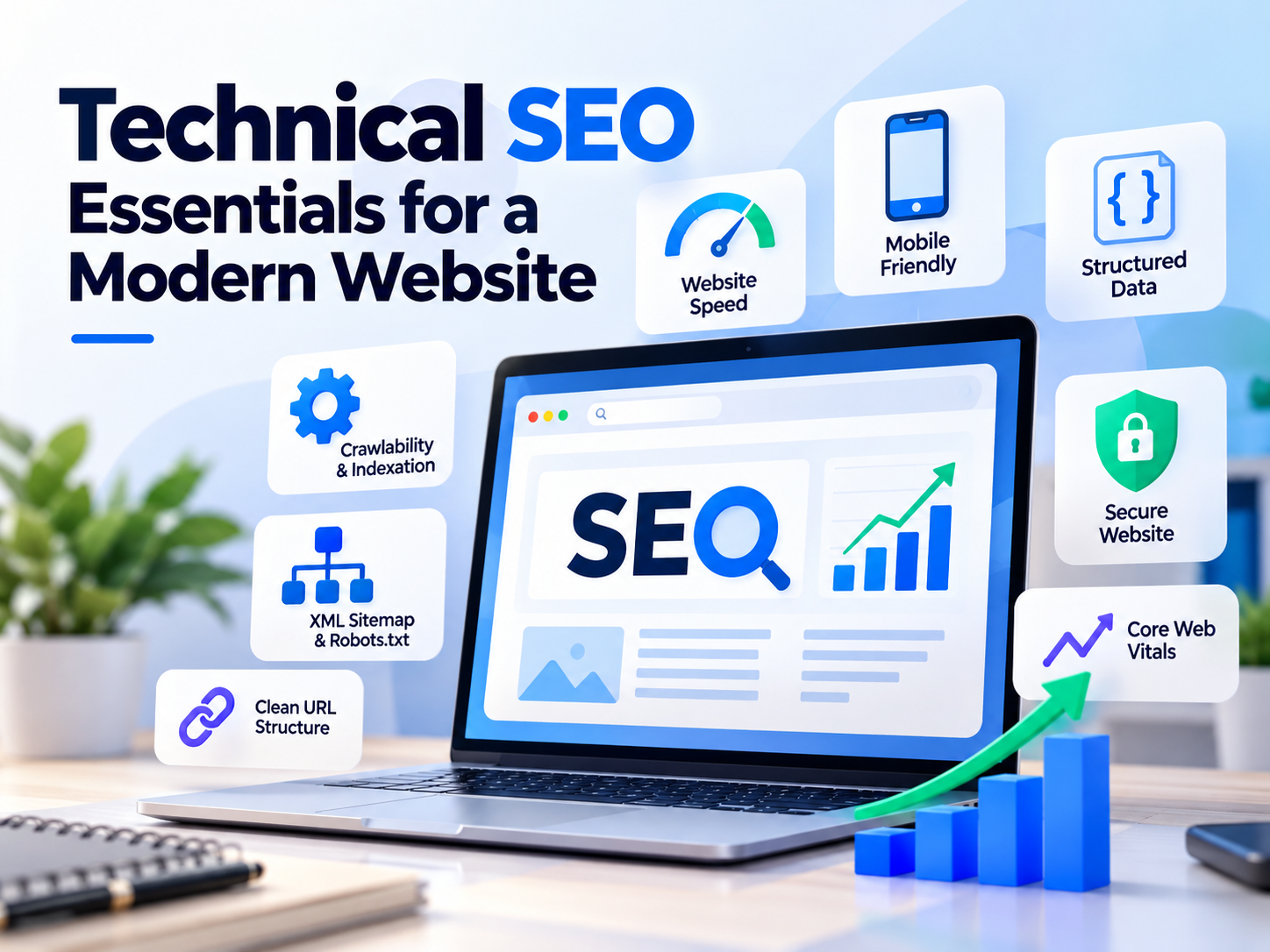
1. Make Your Website Easy to Crawl
Search engines use crawlers to discover and understand website content.
If important pages are difficult to access, your SEO performance can suffer.
A technically optimized website should have:
- Clear internal linking
- Logical URL structures
- Proper navigation
- XML sitemaps
- Correct robots.txt configuration
- No unnecessary crawl barriers
- Proper canonical URLs
A clean architecture also makes it easier for users to navigate your website.
2. Optimize Website Speed
Website performance is an important part of modern SEO and user experience.
Large images, unnecessary JavaScript, excessive CSS, third-party scripts,
and poorly optimized hosting can slow down a website.
Important performance areas include:
- Largest Contentful Paint (LCP)
- Cumulative Layout Shift (CLS)
- Interaction to Next Paint (INP)
- Image optimization
- Browser caching
- Compression
- Efficient CSS and JavaScript
- Proper font loading
- Server response time
Speed optimization should focus on the actual causes of performance issues
rather than simply installing more optimization plugins.
3. Build a Mobile-Friendly Website
Most modern websites receive significant traffic from mobile devices.
Your website should provide a consistent experience across phones, tablets,
laptops, and desktop screens.
Pay attention to:
- Responsive layouts
- Readable typography
- Touch-friendly buttons
- Proper spacing
- Mobile navigation
- Responsive images
- Avoiding horizontal scrolling
Mobile usability should be considered during development rather than treated
as a separate task after desktop design is complete.
4. Use a Clear URL Structure
URLs should be understandable to both users and search engines.
For example:
example.com/services/web-development/
is generally easier to understand than:
example.com/page?id=12345
A good URL structure should be:
- Short and descriptive
- Consistent
- Human-readable
- Organized around your website hierarchy
- Free from unnecessary parameters where possible
Avoid changing URLs unnecessarily once pages have established search visibility.
5. Implement XML Sitemaps
An XML sitemap provides search engines with information about the pages
you want them to discover.
A sitemap should contain important indexable URLs and should be kept clean.
It should generally avoid including pages such as:
- Redirected URLs
- Broken pages
- Duplicate URLs
- Noindex pages
- Irrelevant internal URLs
For larger websites, maintaining a clean sitemap becomes particularly important.
6. Configure Robots.txt Correctly
The robots.txt file provides crawling instructions to search engine bots.
However, blocking a URL in robots.txt does not necessarily mean that the URL
will never appear in search results.
Robots.txt should therefore be configured carefully, particularly on ecommerce
websites, large WordPress installations, and websites containing many dynamic URLs.
A small configuration mistake can unintentionally prevent search engines from
accessing important resources.
7. Use Canonical URLs
Duplicate or very similar pages can create confusion about which URL should
be treated as the primary version.
Canonical tags help communicate the preferred URL to search engines.
They are particularly useful for websites with:
- Ecommerce filters
- Product variations
- Tracking parameters
- Duplicate content
- Pagination structures
- Multiple URL versions
Canonicalization should be implemented based on the website’s actual architecture
rather than automatically adding canonical tags everywhere.
8. Add Structured Data
Structured data helps search engines understand specific types of content.
Depending on the website, useful schema types can include:
- Organization
- Local Business
- Product
- Article
- Breadcrumb
- FAQ
- Event
- Service
- Person
Correctly implemented structured data can also make pages eligible for certain
enhanced search features.
The key is to ensure the markup accurately represents visible page content.
9. Maintain Proper Heading Structure
HTML headings help communicate the hierarchy of your content.
A typical page structure might look like:
- H1 — Main Page Topic
- H2 — Primary Section
- H3 — Supporting Topic
Headings should be used for structure rather than simply styling text.
A clear semantic HTML structure can improve accessibility while also helping
search engines understand page content.
10. Fix Broken Links and Redirects
Broken links create poor user experiences and can make website maintenance
more difficult.
Regular technical SEO audits should identify:
- 404 pages
- Broken internal links
- Redirect chains
- Redirect loops
- Incorrect redirects
- Orphaned pages
When URLs change, implement appropriate 301 redirects
so users and search engines can reach the correct destination.
11. Secure Your Website
HTTPS is now standard for modern websites.
An SSL-secured website protects information transferred between users and
the server and provides a more trustworthy browsing experience.
Technical audits should also check for:
- Mixed content
- Expired certificates
- HTTP-to-HTTPS redirects
- Insecure resources
- Incorrect canonical protocols
Security and SEO should be considered together during website development.
12. Create an SEO-Friendly Website Architecture
Technical SEO works best when it is built into the website architecture
from the beginning.
A strong structure should connect:
Homepage → Service Categories → Individual Services → Supporting Content
This creates a logical relationship between important pages and helps distribute
internal authority throughout the site.
Internal links should also use meaningful anchor text where appropriate.
13. Monitor Technical SEO Continuously
Technical SEO is not a one-time task.
Websites change constantly as developers add pages, update plugins, publish
content, modify templates, and introduce new functionality.
Regular monitoring can identify issues before they become larger problems.
Useful checks include:
- Indexation
- Crawl errors
- Core Web Vitals
- Broken links
- Redirects
- Sitemap status
- Structured data
- Mobile usability
- Page performance
Final Thoughts
Technical SEO provides the foundation for long-term organic search performance.
A modern website should not only look good—it should be
fast, accessible, crawlable, secure, mobile-friendly, and technically well structured.
By addressing technical SEO during the development process, businesses can
create a stronger foundation for content marketing, search visibility,
and a better overall user experience.