


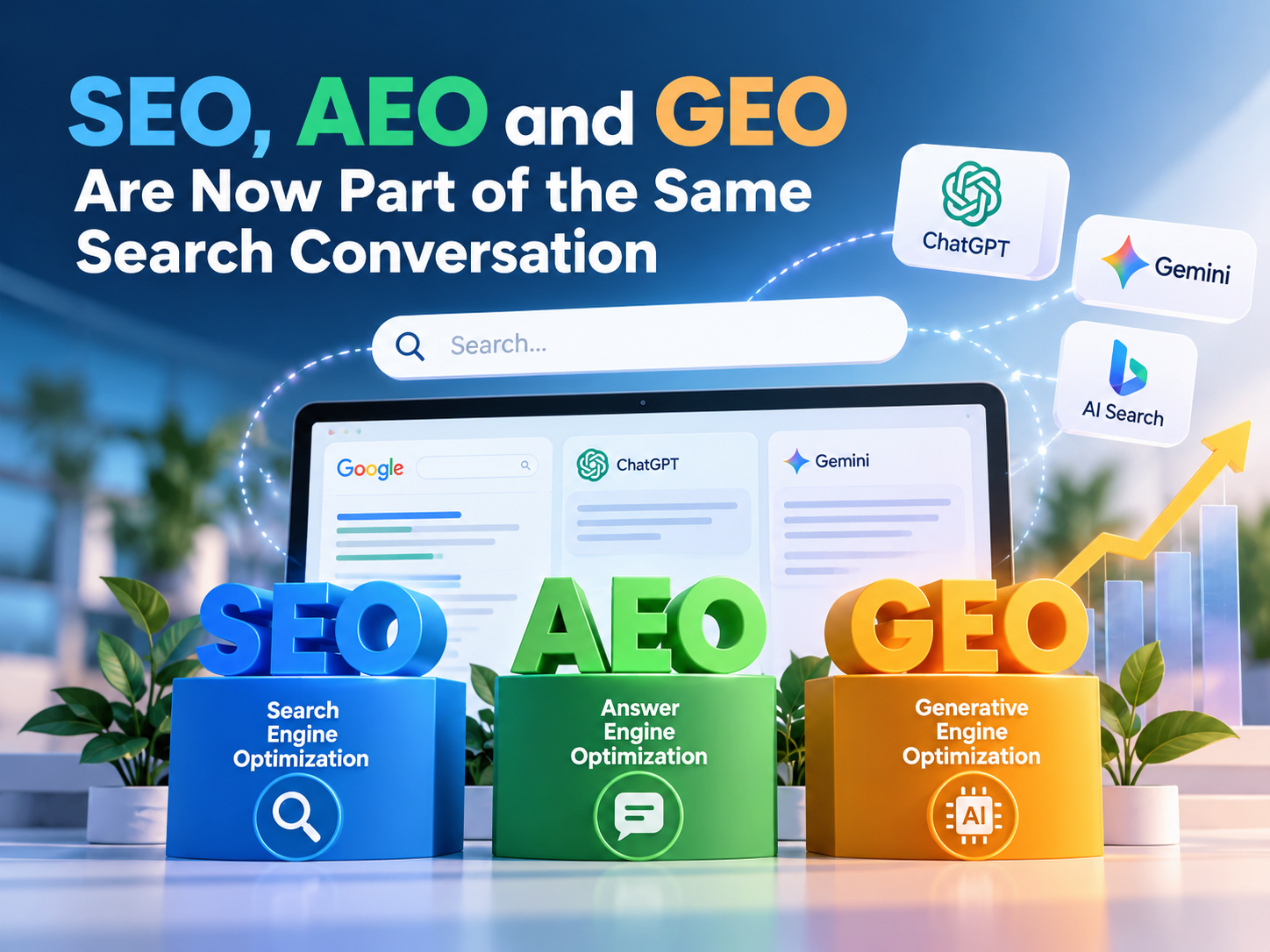
SEO, AEO and GEO Are Now Part of the Same Search Conversation
Search has changed dramatically. For years, businesses could build a website, publish useful pages, earn links, optimize technical elements and focus primarily on ranking in traditional search results. That foundation is still important, but people now discover information through featured snippets, voice assistants, conversational tools and generative AI platforms.
That shift has introduced three commonly used terms: SEO, AEO and GEO. They describe related but different ways of making a business easier to discover.
SEO, or Search Engine Optimization, focuses on improving visibility in search engines. AEO, or Answer Engine Optimization, focuses on earning visibility when platforms provide direct answers to questions. GEO, or Generative Engine Optimization, focuses on helping a business, brand or website become a useful and credible source for AI-generated answers.
The important point is that businesses do not necessarily need three completely separate strategies. The strongest approach is to create genuinely useful content, make it easy for machines to understand, establish credibility and structure information so it can be retrieved and referenced across multiple search experiences.
What Is SEO?
SEO is the process of improving a website so that search engines can crawl, understand, index and rank its content for relevant queries.
A modern SEO program usually includes technical SEO, on-page optimization, content development, internal linking, digital PR or link acquisition, local SEO where appropriate, structured data and performance optimization.
The objective is not simply to attract the largest possible amount of traffic. A page that receives thousands of visits but produces no enquiries may be less valuable than a page that attracts a smaller audience with strong purchase or enquiry intent.
For that reason, effective SEO connects search visibility with business goals. Keyword research should identify what customers actually need, while content should help them solve the problem and understand the next step.
What Is AEO?
Answer Engine Optimization is focused on situations where a search platform attempts to answer a question directly rather than simply displaying a list of links.
Examples include featured snippets, People Also Ask results, voice search responses and other answer-focused experiences. AEO encourages businesses to structure content around real questions and provide concise, reliable answers.
For example, instead of creating a page that repeatedly targets the phrase “website speed optimization,” an AEO-friendly article might answer questions such as “What causes a slow website?” and “How can I improve Core Web Vitals?” It can then expand into detailed explanations, examples and practical recommendations.
What Is GEO?
Generative Engine Optimization is concerned with visibility inside AI-generated search and answer experiences. Users may ask a conversational platform for recommendations, comparisons, explanations or solutions and receive a synthesized answer instead of a traditional results page.
GEO therefore places greater emphasis on clarity, factual depth, entity relationships, source credibility, original insights and content that can be accurately interpreted by language models.
There is no guaranteed formula for being mentioned by an AI system. Generative systems use different retrieval, ranking and generation mechanisms, and their behavior can change. Businesses should therefore avoid promises such as “guaranteed ChatGPT rankings.” The practical goal is to make the organization and its expertise easy to understand and worth referencing.
SEO vs AEO vs GEO: The Key Differences
| Approach | Primary Focus | Typical Experience | Useful Content Pattern |
|---|---|---|---|
| SEO | Search visibility | Traditional search results | Comprehensive pages targeting search intent |
| AEO | Direct answers | Featured snippets, answer interfaces, voice | Clear questions, concise answers and structured explanations |
| GEO | AI-generated discovery | Conversational and generative search | Authoritative, well-structured, context-rich information |
Why Businesses Should Combine Them
These approaches overlap because the same high-quality content can support multiple discovery channels. A well-written service page can rank in Google, answer a specific customer question and provide useful context to an AI retrieval system.
The opportunity is to stop treating search optimization as a collection of isolated tricks. Instead, build a content and website system around customer intent.
- Use SEO research to understand demand.
- Use AEO principles to answer important questions directly.
- Use GEO principles to make expertise and context easy for AI systems to interpret.
- Use technical SEO and structured data to make the site machine-readable.
- Use original evidence, experience and examples to differentiate the content.
How to Build a Search Strategy for 2026
1. Map Topics to Customer Intent
Start with the problems customers are trying to solve. Group keywords and questions into informational, commercial, transactional and navigational intent. This gives your content strategy a business purpose.
2. Build Topic Depth
One article rarely establishes meaningful topical coverage. Build related pages that address the major questions around a service or product and connect them with logical internal links.
3. Make Answers Easy to Extract
Use descriptive headings, short answer paragraphs, lists, comparison tables and clear definitions. This improves usability for people and gives automated systems cleaner information to interpret.
4. Demonstrate First-Hand Expertise
Generic AI-written content is easy to reproduce. Original examples, case studies, processes, screenshots, data and expert commentary make your content more distinctive.
5. Strengthen Trust Signals
Make it clear who is responsible for the content, why the business is qualified to discuss the subject and where important claims come from. Keep company information, contact details and service descriptions consistent across the web.
Common Mistakes to Avoid
One mistake is creating content solely because a keyword has search volume. Another is writing dozens of thin pages that repeat the same information. Businesses should also avoid stuffing exact-match phrases into every paragraph or making unsupported claims about AI visibility.
Another common problem is separating content from the actual customer journey. Search traffic has little value if visitors cannot quickly understand the offer, trust the company and take an appropriate next step.
The Future of Search Is Multichannel
SEO is not disappearing. Instead, search is becoming more distributed. A customer may discover a company through Google, validate it through reviews, ask an AI assistant for alternatives, watch a short video and finally visit the company’s website before contacting the business.
Businesses that build useful, trustworthy and technically accessible digital properties can participate in more of these discovery moments.
Final Takeaway
SEO, AEO and GEO should not be treated as competing disciplines. They are different lenses for the same fundamental objective: helping the right audience discover and understand your business.
Build strong pages around real customer needs, answer questions clearly, demonstrate expertise, structure information properly and connect search visibility to measurable business outcomes. That approach is more durable than chasing individual platform features or short-term ranking tactics.