

AI Search Is Changing How People Discover Businesses
Search is becoming more conversational. Instead of entering several short keywords into a search box, users can ask an AI system a detailed question and receive a synthesized response. They may then ask follow-up questions, compare options and request recommendations.
For businesses, this creates a new discovery opportunity. It also creates a new challenge: your website needs to be understandable not only to people and traditional search engines, but also to systems that retrieve and synthesize information from many sources.
There is no single optimization switch for ChatGPT, Gemini or other AI platforms. However, there are practical steps that improve the likelihood that your content can be discovered, understood and used accurately.
1. Build Pages Around Real Questions
AI search users often ask complete questions rather than typing short keyword fragments. Your content should reflect that behavior.
Create sections that answer questions customers actually ask before buying. For a web agency, these might include “How much does a business website cost?”, “What makes a website generate leads?” and “Should a small business use WordPress or Shopify?”
Answer the question directly first, then provide the supporting detail. This structure is useful for readers and easier for automated systems to interpret.
2. Make Your Business Entity Clear
AI systems need context. Your website should clearly communicate what your company is, what it offers, where it operates and who it serves.
Maintain consistent information across your homepage, About page, service pages, contact details and relevant external profiles. Use the same company name, core service terminology and geographic information where appropriate.
3. Create Deep, Useful Service Pages
Do not rely on a single generic Services page. Build detailed pages for your major services and explain the problems each service solves, the process, expected deliverables, suitable customer types and frequently asked questions.
A strong service page can become the central source that other content references. It also gives visitors a clear path from research to enquiry.
4. Publish Original Expertise
AI systems can summarize information that already exists. That makes original material increasingly valuable.
Share your own processes, lessons, case studies, benchmarks, project examples, before-and-after findings and expert opinions. If your agency has completed a website performance project, explain what was changed and what was measured rather than publishing another generic article about website speed.
5. Use Clear Information Architecture
Organize your website logically. A visitor and a machine should be able to understand the relationship between your company, services, industries, locations and supporting resources.
- Use descriptive page titles.
- Use a logical heading hierarchy.
- Link related pages together.
- Keep URLs readable.
- Avoid unnecessary duplicate pages.
- Maintain accurate navigation and breadcrumbs.
6. Add Structured Data Where It Fits
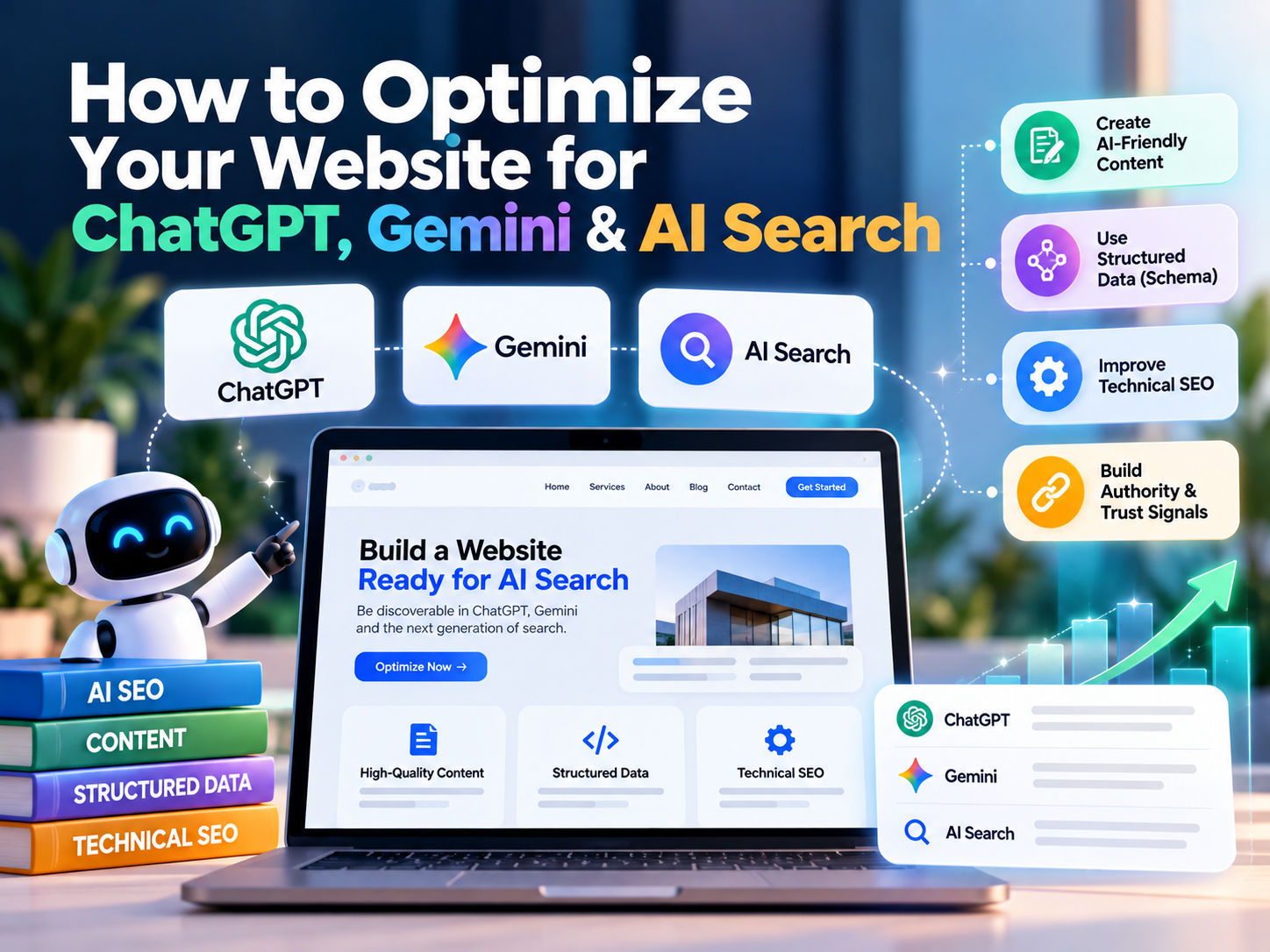
Schema markup can help search engines understand entities and page types. Depending on the website, relevant structured data may include Organization, LocalBusiness, Article, Product, Service, BreadcrumbList and FAQ-related information where supported and appropriate.
Structured data should describe visible, accurate content. It should not be used to manufacture claims or add information that visitors cannot verify on the page.
7. Improve Technical Accessibility
A technically weak website makes discovery harder. Make sure important content is available in crawlable HTML, pages return appropriate status codes, internal links work, canonicalization is correct and the site does not depend on inaccessible client-side behavior for essential information.
Performance matters as well. Optimize images, reduce unnecessary JavaScript, use appropriate caching and monitor Core Web Vitals.
8. Make Content Easy to Quote Accurately
AI-generated answers need reliable source material. Avoid burying important definitions inside long promotional paragraphs. Use clear terminology and concise explanations.
For example, begin a section with a direct definition, then explain the implications and provide examples. This creates a useful information hierarchy.
9. Build External Authority
Your website is not the only source an AI system can use to understand your organization. Relevant third-party mentions, reputable directories, industry publications, partnerships, interviews and reviews can contribute to the broader digital footprint of a business.
Focus on legitimate authority rather than artificial link schemes. The objective is to become recognized as a real organization with expertise, not simply to accumulate mentions.
10. Keep Information Current
AI search increases the importance of accurate business information. Review pricing references, service descriptions, staff pages, case studies, policies and contact information regularly.
Remove obsolete claims and update articles when the underlying subject changes. Add visible publication or update dates when they help users understand freshness.
What You Should Not Do
Avoid tactics promising guaranteed inclusion in ChatGPT or another AI system. No website owner controls how an external AI platform retrieves, ranks or generates every answer.
Also avoid mass-producing shallow articles simply to increase page count. More content does not automatically mean more visibility. A smaller collection of genuinely useful resources can be more valuable than hundreds of repetitive pages.
A Practical AI Search Checklist
- Clearly explain who your company is and what it does.
- Create detailed pages for important services and topics.
- Answer customer questions directly.
- Use descriptive headings and internal links.
- Publish original experience and evidence.
- Implement relevant technical SEO and structured data.
- Maintain accurate business information across the web.
- Improve accessibility and page performance.
- Earn legitimate mentions and reviews.
- Review and update important content regularly.
Final Takeaway
Optimizing for AI search is less about trying to “hack” an AI answer and more about becoming an excellent source of information. A technically sound website with clear structure, strong expertise, useful answers and consistent business information gives search systems more reliable material to work with.