

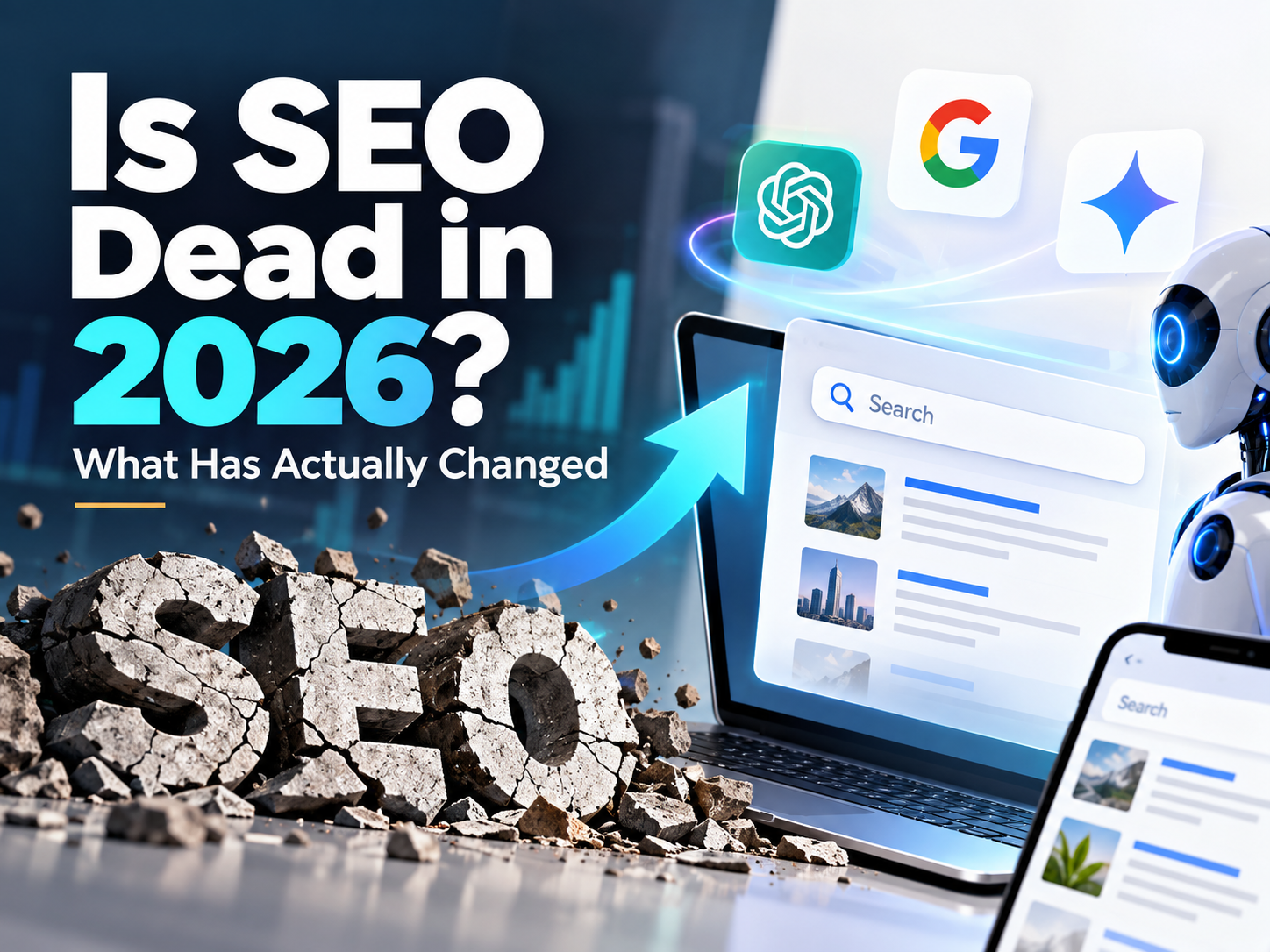
SEO Has Not Disappeared. The Search Environment Has Expanded.
“Is SEO dead?” is an understandable question. Search results are changing, AI-generated answers are becoming more common and users can sometimes find information without clicking a traditional result.
But SEO remains relevant because people still use search systems to discover information, products, services, businesses and solutions. What has changed is the definition of search visibility.
What Has Changed?
Search Results Are More Diverse
A traditional list of ten blue links is no longer the only search experience. Results can include maps, images, videos, shopping experiences, featured answers, discussions and other specialized features.
AI Is Changing the Research Journey
Users can ask conversational systems to summarize a subject or compare options. This means a business can be discovered without the user immediately clicking through from a traditional results page.
Content Quality Expectations Are Higher
Publishing a generic article for every keyword is less compelling than creating useful resources with real expertise, evidence and a clear purpose.
Why Traditional SEO Still Matters
Technical accessibility, crawlability, indexing, internal linking, relevant content, authority and user experience remain foundational. AI-driven discovery does not eliminate the need for websites to be understandable and accessible to search systems.
SEO also supports discovery throughout the customer journey. People still search for businesses, products, reviews, pricing, local services and answers to specific questions.
The New SEO Objective: Become the Best Source
Instead of asking only “How do I rank for this keyword?”, marketers should also ask “What information does the customer need to make a decision, and can our website provide the clearest source?”
This encourages deeper content, stronger service pages, original examples and better internal linking.
Zero-Click Searches Change Measurement
Some searches can be answered directly on a results page. That may reduce clicks for certain informational queries. However, visibility itself can still influence awareness and later branded searches.
Businesses should therefore use multiple metrics. Track organic traffic, qualified enquiries, branded demand, conversions and revenue rather than treating clicks as the only measure of SEO value.
AI-Generated Content Does Not Make Strategy Irrelevant
AI can help with research and drafting, but large-scale production of generic content can create sameness. Businesses need editorial standards, fact checking and original contributions.
The competitive advantage comes from knowledge that is difficult to copy: customer experience, proprietary data, expert processes, case studies and strong points of view.
What a Modern SEO Strategy Looks Like
- Technical SEO foundation.
- Search intent research.
- Useful service and product pages.
- Topic clusters and internal linking.
- Original expertise and evidence.
- Local optimization where relevant.
- Structured data where appropriate.
- Strong page experience and accessibility.
- Digital PR and legitimate authority building.
- Measurement connected to business outcomes.
What Businesses Should Stop Doing
Stop treating keyword density as the primary measure of content quality. Stop publishing near-duplicate pages solely to capture small variations of the same query. Stop measuring SEO exclusively by rankings for a handful of keywords.
Also be cautious with guarantees about AI visibility or permanent rankings. Search systems change, competitors change and user behavior changes.
Final Takeaway
SEO is not dead in 2026. It is becoming broader and more connected to content quality, brand authority, user experience and AI-driven discovery.
The businesses that adapt are not abandoning SEO. They are expanding the goal from “rank a page” to “become a trusted, useful source wherever customers search.”