

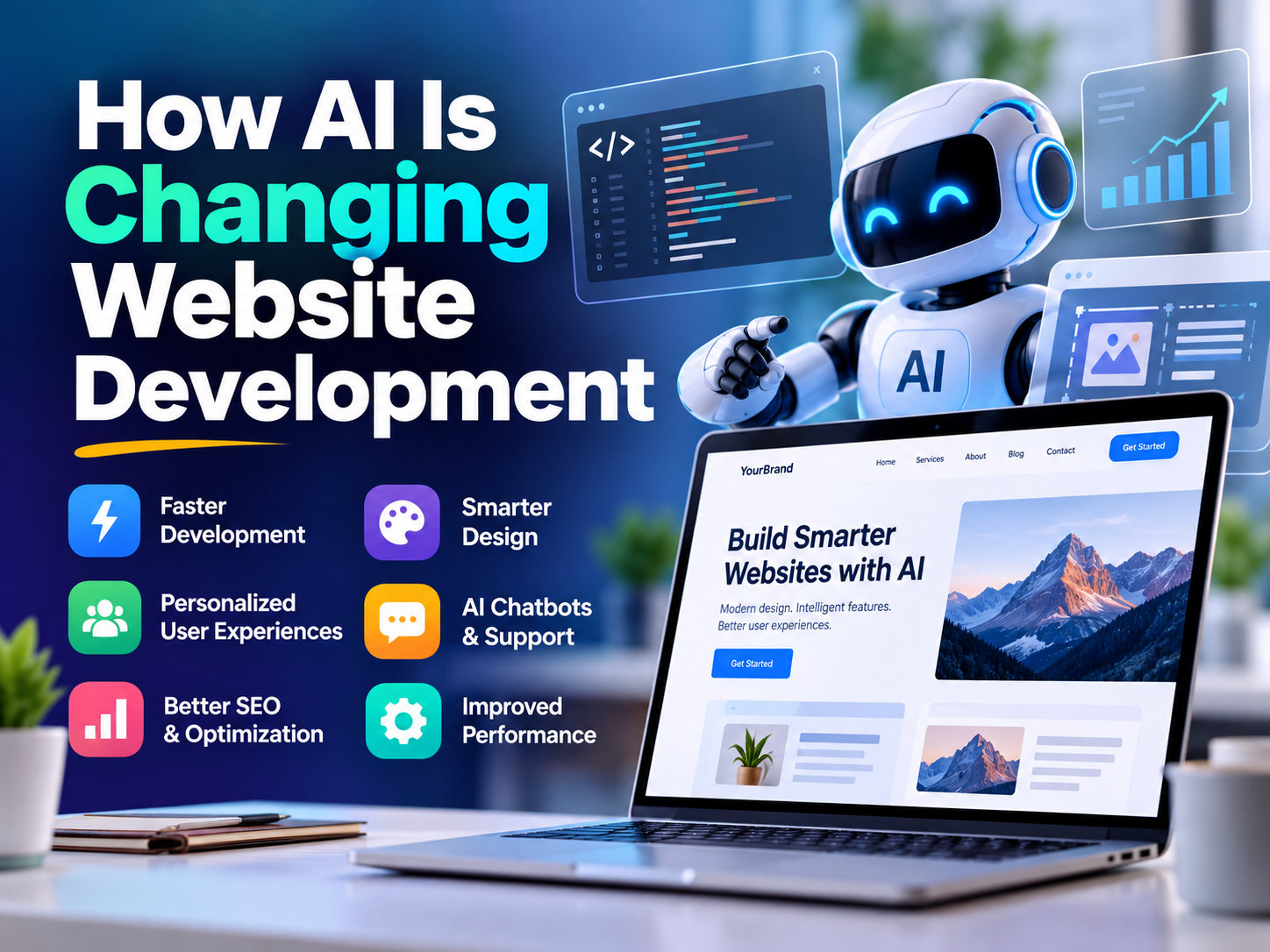
How AI Is Changing Website Development
Artificial intelligence is transforming the way websites are designed,
developed, optimized, and maintained. What once required hours of manual
coding, testing, content creation, and analysis can now be accelerated
with AI-powered tools and workflows.
From generating code to improving user experiences,
AI website development is helping businesses create
websites that are faster, smarter, more personalized, and easier to maintain.
But AI is not simply replacing traditional web development. Instead, it
is giving developers better tools to solve problems, automate repetitive
tasks, and focus more on strategy, creativity, and user experience.
1. Faster Website Development
One of the biggest advantages of AI in web development is speed.
AI-powered development tools can assist developers with:
- Generating HTML, CSS, JavaScript, PHP, and other code
- Creating reusable components
- Finding and explaining coding errors
- Refactoring existing code
- Generating documentation
- Creating test cases
- Automating repetitive development tasks
This can significantly reduce the time required to build and launch
website features.
Developers can use AI as a development assistant while still reviewing,
testing, and validating the generated code.
2. AI Is Improving Website Design
AI is also changing how websites are designed.
Modern AI tools can help generate:
- Website layouts
- UI concepts
- Color combinations
- Typography suggestions
- Content structures
- Responsive design ideas
- Landing page variations
Instead of starting every project from scratch, designers and developers
can use AI to quickly explore multiple concepts before selecting and
refining the right direction.
The result is a more efficient design process without removing the
importance of human creativity and brand strategy.
3. More Personalized User Experiences
Personalization is becoming increasingly important for modern websites.
AI can analyze user interactions and help websites deliver more relevant
experiences based on factors such as:
- Previous interactions
- Browsing behavior
- Content preferences
- Purchase history
- Search activity
- Customer segments
For example, an eCommerce website can recommend products based on a
visitor’s previous activity, while a service website can dynamically
highlight content relevant to different audiences.
This creates a more relevant experience for visitors and can help
businesses improve engagement and conversions.
4. AI-Powered Chatbots and Customer Support
AI-powered chatbots are becoming a common feature on business websites.
Instead of relying exclusively on traditional contact forms, businesses
can provide visitors with immediate answers to common questions.
AI chatbots can assist with:
- Product questions
- Service information
- Appointment requests
- Order-related questions
- Lead qualification
- Frequently asked questions
- Basic customer support
When properly integrated, AI can provide 24/7 assistance while allowing
human teams to focus on more complex customer requests.
5. Smarter SEO and Content Optimization
AI is also changing how businesses approach search engine optimization.
AI tools can help developers and marketing teams identify opportunities
related to:
- Keyword research
- Content structure
- Search intent
- Metadata
- Internal linking
- Content optimization
- Schema markup
- Search performance
However, successful SEO still requires high-quality, useful content and
a strong understanding of the target audience.
AI can accelerate the process, but human review remains important for
accuracy, originality, brand voice, and search quality.
6. Better Website Performance
Website performance directly affects user experience.
AI-assisted development can help identify potential performance problems,
including:
- Large images
- Unused code
- Slow-loading resources
- JavaScript bottlenecks
- Poor caching strategies
- Layout shifts
- Inefficient database queries
Developers can then use these insights to improve loading times and
optimize websites for different devices and network conditions.
A fast website is particularly important for mobile users, where slower
connections and limited device resources can make performance issues
more noticeable.
7. AI Is Helping With Testing and Quality Assurance
Testing is another area where AI can improve the development workflow.
AI-assisted testing can help developers identify potential problems
across different browsers, devices, and user journeys.
Development teams can use AI alongside automated tools to assist with:
- Functional testing
- Regression testing
- Accessibility checks
- Code analysis
- Security reviews
- Responsive testing
- Error detection
This can make quality assurance more efficient while still requiring
human validation for critical functionality.
8. AI and Accessibility
Accessibility is an increasingly important part of professional website
development.
AI can assist developers in identifying potential accessibility problems
such as:
- Missing alternative text
- Poor heading structures
- Insufficient color contrast
- Form usability issues
- Keyboard navigation problems
- Incorrect semantic markup
AI should complement established accessibility testing methods rather
than replace manual testing and assistive-technology testing.
9. AI Is Changing the Role of Web Developers
AI does not eliminate the need for experienced developers.
Instead, the role of developers is evolving.
Developers increasingly need to understand how to:
- Work with AI-assisted development tools
- Review generated code
- Design scalable architectures
- Integrate APIs and AI services
- Protect user data
- Optimize performance
- Test applications
- Build secure systems
- Understand business requirements
The developer becomes less focused on repetitive tasks and more focused
on architecture, problem-solving, quality, security, and delivering
business outcomes.
10. The Future of AI Website Development
The future of web development is likely to combine AI automation with
human expertise.
We can expect continued growth in areas such as:
- AI-generated website components
- Intelligent search
- Conversational interfaces
- Automated personalization
- AI-powered analytics
- Predictive recommendations
- Automated testing
- AI-assisted accessibility
- Dynamic content experiences
- Smarter eCommerce platforms
Businesses that adopt these technologies thoughtfully can create websites
that are more efficient and responsive to customer needs.
Final Thoughts
AI website development is changing nearly every stage
of the website lifecycle, from initial design and coding to testing,
personalization, SEO, and ongoing optimization.
The most effective approach is not to treat AI as a replacement for
developers. Instead, businesses can combine
AI-powered tools with experienced web development
to improve productivity while maintaining security, performance,
accessibility, and quality.
As AI technology continues to evolve, websites will become increasingly
intelligent and personalized. Businesses that build flexible, scalable
digital experiences today will be better positioned to take advantage
of what comes next.