

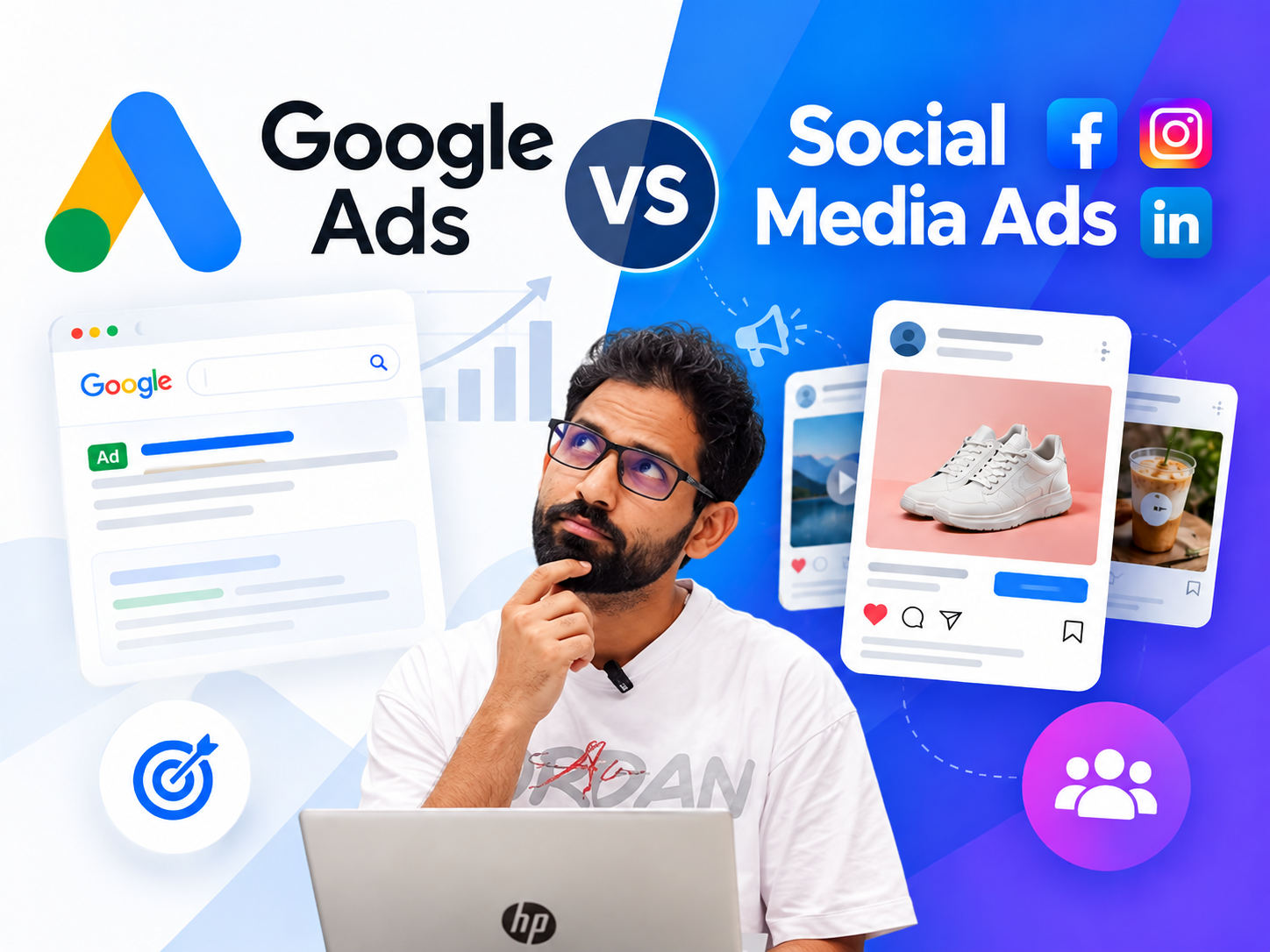
Google Ads vs Social Media Ads: What Should You Choose?
Businesses today have more ways to reach potential customers than ever before.
Two of the most widely used paid advertising channels are
Google Ads and social media ads.
But which one should your business use?
The answer depends on your goals, audience, budget, product or service,
and where your potential customers are in the buying journey.
Google Ads generally focuses on capturing existing search intent,
while social media advertising can help businesses reach people based on
interests, behaviors, demographics, and other audience signals.
Understanding the difference can help you build a more effective paid
advertising strategy.
1. How Google Ads Works
Google Ads allows businesses to advertise across Google’s search and
advertising ecosystem.
With Search Ads, businesses can target people who are actively searching
for products, services, or information.
For example, someone searching for:
“Web design agency near me”
already has a specific need.
A relevant Google Search Ad can appear when that person is looking for
a solution.
This makes Google Ads particularly useful for capturing demand that
already exists.
2. How Social Media Ads Work
Social media advertising works differently.
Platforms such as Facebook and Instagram allow advertisers to reach
audiences based on available targeting signals such as demographics,
interests, behaviors, location, and interactions.
Instead of waiting for someone to search for your product, you can
introduce your business to potential customers while they are browsing
social content.
This can be particularly useful for:
- Building brand awareness
- Introducing new products
- Promoting visual products
- Growing audiences
- Generating leads
- Retargeting website visitors
- Promoting offers and campaigns
3. Search Intent vs Audience Discovery
One of the biggest differences between the two channels is
user intent.
Google Ads can reach users at the moment they actively search for something.
Social media advertising can reach people before they necessarily have
a specific search intent.
For example:
Google Ads
“Buy running shoes online”
Social Media Ad
A person interested in fitness sees an advertisement for a new
running shoe collection.
Both approaches can be valuable, but they address different stages
of the customer journey.
4. Targeting Options
Both platforms provide sophisticated targeting capabilities, although
the mechanisms differ.
Google Ads
Google Ads can use signals such as:
- Search queries
- Keywords
- Location
- Device
- Audience segments
- Remarketing audiences
Social Media Advertising
Social media platforms can use available signals such as:
- Demographics
- Interests
- Behaviors
- Location
- Engagement
- Website activity
- Customer lists
- Lookalike or similar audience approaches, where available
The right targeting strategy depends heavily on your business model
and customer journey.
5. Which One Costs More?
There is no universal answer to whether Google Ads or social media
advertising is cheaper.
Advertising costs can vary depending on:
- Industry
- Competition
- Audience
- Location
- Ad quality
- Campaign objective
- Keywords
- Creative quality
- Landing page experience
- Conversion rate
Instead of looking only at the cost per click, businesses should evaluate
metrics such as cost per lead, cost per acquisition, conversion rate,
and return on advertising spend (ROAS) where appropriate.
6. Google Ads for High-Intent Searches
Google Ads can be particularly useful when customers already know
what they need.
For example:
- Emergency plumbing
- Legal services
- Software solutions
- Local services
- Professional services
- Ecommerce searches
- Business-to-business services
When someone searches for a specific solution, the advertiser has
an opportunity to appear at a highly relevant moment.
7. Social Media Ads for Discovery and Awareness
Social media advertising can be effective for businesses that benefit
from visual storytelling, discovery, and audience engagement.
Examples include:
- Fashion brands
- Beauty products
- Restaurants
- Fitness brands
- Consumer products
- Lifestyle businesses
- New product launches
Strong visuals, videos, offers, testimonials, and creative messaging
can help capture attention in social feeds.
8. Retargeting Can Connect Both Strategies
Retargeting can play an important role in a broader paid media strategy.
For example, someone may:
- Discover your business through social media.
- Visit your website.
- Leave without purchasing.
- Search for your business later.
- Click a Google Ad.
- Complete a purchase or enquiry.
Customers don’t necessarily interact with a business through only
one advertising channel.
Using multiple channels can help businesses maintain visibility
throughout different stages of the customer journey.
9. Your Landing Page Matters
Getting someone to click an advertisement is only the beginning.
Your landing page should match the promise made in the advertisement.
Important elements include:
- Clear headline
- Relevant offer
- Strong call to action
- Mobile-friendly design
- Fast loading speed
- Trust signals
- Simple navigation
- Easy-to-use forms
A well-optimized advertising campaign can still perform poorly if
the landing page creates friction.
10. When Should You Use Google Ads?
Google Ads may be worth considering when:
- Customers actively search for your services.
- You operate in a high-intent market.
- You want to generate leads or sales.
- You have clearly defined search terms.
- Your business serves a specific geographic area.
- You want to capture existing demand.
The most important consideration is whether your target audience
is actually searching for what you offer.
11. When Should You Use Social Media Ads?
Social media advertising may be useful when:
- Your product is highly visual.
- You want to introduce your brand to new audiences.
- Your audience spends significant time on social platforms.
- You have strong creative assets.
- You want to promote a new product or offer.
- You want to build awareness and generate demand.
Creative testing can also be an important part of social advertising
because different messages and visuals can produce very different results.
12. Should You Use Both?
For many businesses, the decision doesn’t have to be
Google Ads vs Social Media Ads.
A combined strategy can allow each channel to perform a different role.
For example:
Social Media Ads → Awareness → Website Visit → Retargeting →
Google Search → Conversion
The actual customer journey will vary by industry, audience, and campaign.
The goal should be to understand where each advertising channel fits
into your overall marketing strategy.
Final Thoughts
Google Ads and social media ads serve different purposes.
Google Ads can help businesses capture existing demand from people
actively searching for products and services. Social media advertising
can help businesses reach potential customers through audience targeting,
discovery, and engaging creative content.
Rather than choosing a platform based solely on advertising cost,
consider your:
- Business goals
- Target audience
- Customer journey
- Search demand
- Advertising budget
- Product or service
- Creative assets
- Conversion goals
A data-driven paid advertising strategy can then determine where
your budget is best allocated and how different channels can work together.
Target Services
Google Ads Management • PPC Advertising • Social Media Advertising •
Facebook & Instagram Ads • Google Search Ads • Google Shopping Ads •
Remarketing • Paid Media Strategy • Conversion Optimization •
Digital Marketing